
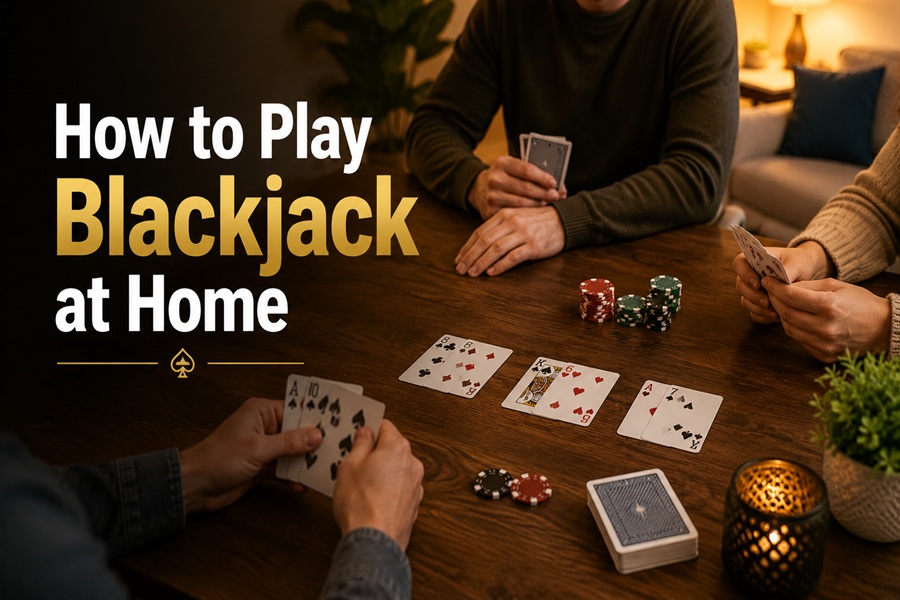

To play blackjack at home, you need a deck of cards (jokers removed), some chips or tokens, and at least two people. One person acts as the dealer. Players try to build a hand closer to 21 than the dealer’s without going over. The dealer follows a fixed rule — hit on 16, stand on 17 — and in a home game, players rotate the dealer role so nobody keeps the house edge all night.
Here’s everything you need to run a smooth, fun, fair game.
What do you need to play blackjack at home?
Keep it simple. The essentials:
- Cards: One or two standard 52-card decks. For a livelier game with more players, shuffle two decks together. Remove the jokers before you start.
- Chips or tokens: Poker chips are ideal. Assign colors to values so betting feels real. No chips? Use coins, candy, or matchsticks.
- A flat surface: A table works fine. A felt mat adds a casino feel but isn’t required.
- Optional extras: A discard tray for used cards, a “dealer button” to track whose turn it is to deal, and some Vegas-style music if you want the atmosphere.
That’s it. You don’t need a professional pit to have a great night.
What is the goal of blackjack?
The goal is to get your hand total as close to 21 as possible without going over. Going over 21 is a “bust,” and you lose instantly.
You’re not competing against the other players. Everyone plays against the dealer. You win if your hand beats the dealer’s without busting.
Card values, quickly:
- 2–9: face value.
- 10, Jack, Queen, King: all worth 10.
- Ace: 1 or 11, whichever helps.
An Ace plus any 10-value card in your first two cards is a blackjack — an instant strong win, usually paid at 3:2.
How do you set up the game?
Follow these steps to get started:
- Pick the first dealer. Draw cards — highest (or lowest) card deals first. Or just volunteer someone.
- Hand out chips. Give every player an equal starting stack so the game is even.
- Set the betting limits. Agree on a minimum and maximum bet before any cards come out.
- Lock in your house rules. Decide the details now (see the house-rules section below) so there are no arguments mid-game.
- Shuffle and you’re ready.
How do you deal and play a round?
Here’s the flow of a single hand, step by step.
- Players bet first. Everyone who wants in places their chips in front of them. No bet means no cards that round.
- Deal the cards. Starting from the dealer’s left and moving clockwise, deal each player one card face-up, then one to the dealer. Repeat so everyone has two cards. The dealer’s second card goes face-down (the “hole” card).
- Check for blackjack. If any player has an Ace and a 10-value card, that’s a blackjack — an automatic win unless the dealer also has one.
- Players take their turns. Going clockwise, each player decides what to do (see the moves below). They can take as many cards as they like but bust if they pass 21.
- Dealer reveals and plays. After all players finish, the dealer flips the hole card and draws according to the fixed rule.
- Settle up. The dealer pays winners and collects from losers based on your house rules.
What are the player’s moves?
Make sure everyone knows these four core actions before you start:
- Hit: Take another card to raise your total.
- Stand: Keep your total and end your turn.
- Double Down: Double your original bet and take exactly one more card.
- Split: If your two cards are a pair (same value), place a second equal bet and play them as two separate hands.
One optional move worth adding for a friendly game:
- Surrender: Give up a bad hand and get half your bet back. It’s a nice option for beginners and preserves chips.
What rules does the dealer have to follow?
This is the heart of a fair home game. Unlike players, the dealer has no choices. They follow a fixed rule:
- Hit on 16 or less.
- Stand on 17 or more.
Some tables specify whether the dealer hits or stands on a “soft 17” (a 17 that includes an Ace counted as 11). Standing on all 17s is slightly better for players — a common house-rule choice at home.
Because the dealer always acts last, and ties usually go to the dealer, the dealer holds the house edge. That’s exactly why home games rotate the role.
How do you rotate the dealer at home?
This is the key difference between a home game and a casino. In a casino, the house is always the dealer. At home, that’s unfair to whoever gets stuck dealing, so you share it.
Two popular methods:
- Rotate every hand. Like home poker, the deal passes clockwise after each round. Use a dealer button to track it. Everyone takes turns being the house.
- Rotate every 5–10 hands. The dealer role changes on a set interval. This keeps things flowing while still spreading the advantage around.
Acting last is an advantage, so make sure the deal — and the last-to-act position — moves around so it’s balanced by the end of the night.
What house rules should you agree on first?
Set these before the first card is dealt to avoid disputes:
| Rule to decide | Common home choice |
|---|---|
| Number of decks | One or two |
| Blackjack payout | 3:2 (player-friendly) |
| Dealer on soft 17 | Stand (player-friendly) |
| Doubling allowed on | Any two cards |
| Splitting pairs | Allowed; re-splitting optional |
| Surrender | Optional, good for beginners |
| Ties (push) | Bet returned, or “dealer wins” |
| Betting limits | Set a clear min and max |
Write them down if your group is competitive. Clear rules keep the night fun.
Is it legal to play blackjack for money at home?
In most of the U.S. and U.K., a private, recreational blackjack game is legal under “social gambling” rules — but there’s a golden rule:
The host (the “house”) must not take a cut or “rake” from the betting. The moment the host profits from running the game rather than from playing it, you can cross from social gambling into something regulated.
A few pointers:
- Keep it a private, social setting among friends.
- Don’t charge an entry fee to play.
- Rules vary by state and country, so check your local laws if real money is involved.
- For a worry-free night, many hosts use symbolic stakes — chips for bragging rights, or small prizes instead of cash.
Fun home variations to try
Once everyone knows the basics, mix it up:
- Face-up blackjack: Deal every card face-up. The whole table plays against the dealer’s visible hand as a group. Great for teaching beginners.
- Tournament style: Everyone starts with equal chips and plays for a set time. Most chips at the end wins. Use a timer rather than a hand count, so the last-to-act advantage stays unknown until the finish.
- Two-player games: No crowd needed. One person deals, the other plays, and you swap roles. It works perfectly for practice.
- Chip countdown finish: A few hands before the end, count everyone’s chips so players know where they stand for a dramatic final round.
Beginner tips for a smooth game night
- Teach the values first. Make sure everyone knows 10, J, Q, K all equal 10 and the Ace is 1 or 11.
- Assume the dealer’s hole card is a 10. There are 16 ten-value cards in a deck, so it’s the smart default.
- Don’t split 10-value pairs. Two face cards make 20 — a strong hand. Keep it.
- Keep stakes low. The goal is fun, not for anyone to lose their shirt.
- Have an end time. Decide when the night wraps so it ends on a high note.
Frequently asked questions
How many people do you need to play blackjack at home?
Just two — one dealer and one player. It also scales well up to about seven players per deck.
Do you remove the jokers?
Yes. Blackjack uses only the standard 52 cards. Take the jokers out before shuffling.
Does the dealer have to hit or stand on a set number?
Yes. The dealer hits on 16 or less and stands on 17 or more. They have no free choice.
Who wins a tie in blackjack?
Usually it’s a “push” — your bet is returned. Some home games rule ties in the dealer’s favor. Decide up front.
Is playing blackjack at home for money legal?
In many places, yes, under social gambling rules — as long as the host doesn’t take a rake or charge to play. Check your local laws.
This article is for informational and entertainment purposes only. Gambling laws vary by location, and gambling carries financial risk.