
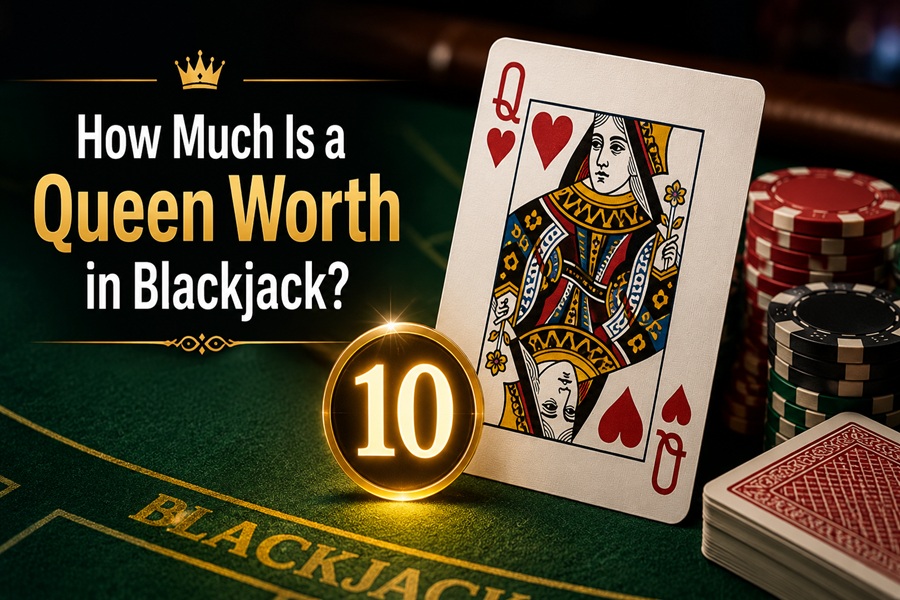

A Queen is worth 10 points in blackjack. Every Queen — Hearts, Diamonds, Clubs, Spades — carries the same value. It’s identical to a King, a Jack, or a 10. Simple as that.
But “simple” doesn’t mean there’s nothing to know. Beginners carry a surprising number of wrong assumptions about the Queen. This guide clears them up, myth by myth, then shows you the hands a Queen actually creates.
How much is a Queen worth in blackjack?
10 points. No exceptions in standard blackjack.
The Queen belongs to the 10-value card family: the 10, Jack, Queen, and King. All four are worth 10. The suit is irrelevant. A Queen of Spades and a Queen of Hearts are worth precisely the same.
That’s the whole answer to the value question. Now let’s kill the myths that trip people up.
Myth vs. fact: what people get wrong about the Queen
| Myth | Fact |
|---|---|
| “A King beats a Queen, so it’s worth more.” | False. Both are worth 10. Poker rankings don’t exist in blackjack. |
| “The Queen of a matching suit is worth more.” | False. Suit never affects value in blackjack. |
| “A Queen is a weak card.” | False. It’s a 10 — a strong building block toward 21. |
| “Two Queens should be split.” | False. Two Queens make 20. Stand. |
| “A Queen and Ace isn’t a real blackjack.” | False. Ace + Queen in your first two cards is a natural 21. |
The root of most confusion is poker. In poker, the Queen sits below the King and above the Jack. New blackjack players carry that ranking with them and assume it must matter. It doesn’t. At the point-value level, the face cards are perfectly equal.
What card values does blackjack use?
Here’s the full system, so the Queen makes sense in context:
- Cards 2–9: worth their printed number. A 6 is 6, an 8 is 8. Suit is irrelevant.
- 10-value cards (10, J, Q, K): each worth 10.
- Ace: worth 1 or 11, whichever helps your hand most.
To total a hand, just add. A Queen and a 9 is 19. A Queen and a 5 is 15. A Queen and an Ace is 21.
Why does the Queen’s value matter so much?
Because Queens are part of a very crowded club.
A standard deck contains 16 ten-value cards — four 10s, four Jacks, four Queens, and four Kings. That’s roughly 31% of the deck. The consequences ripple through the whole game:
- 10 is the most likely value to be drawn. Smart players assume the dealer’s hidden card is a 10.
- Reaching a strong total is common. With so many 10s in circulation, hands like 20 show up often.
- Basic strategy is built around it. Correct decisions assume a high probability of the next card being a 10-value.
So the Queen isn’t important because it’s a Queen. It’s important because it’s one of 16 cards that all push you toward — or past — 21.
What blackjack hands does a Queen make?
Let’s look at the Queen in action.
- Queen + Ace → a natural blackjack (21) if they’re your first two cards. This typically pays a 3:2 bonus. A $20 bet returns $30 in winnings.
- Queen + 10-value card → a total of 20. One of the best hands you can hold. Stand and let the dealer sweat.
- Queen + 9 → 19. Very strong. Stand.
- Queen + low card → a “stiff” total (12–16). Now you lean on basic strategy and the dealer’s up-card to decide whether to hit.
One rule about that natural blackjack: it must be your first two cards. A Queen that helps you reach 21 across three or more cards is still a winner, but it usually pays even money — not the 3:2 bonus.
The one split you should never make with Queens
Here’s the mistake that quietly drains bankrolls, echoed in nearly every beginner thread on Reddit’s r/blackjack and Quora blackjack questions:
Never split a pair of Queens. Two Queens equal 20 — a near-winning hand. Splitting breaks that powerhouse into two separate hands starting at 10 each, doubles your money at risk, and almost always lowers your expected return. It looks bold. It plays badly.
The same logic applies to any pair of 10-value cards. If you’re holding 20, you’re already in great shape. Don’t trade a strong hand for two weaker ones.
Does the Queen’s value change in any blackjack variant?
The Queen stays at 10 across essentially every version of blackjack — classic, European, Vegas Strip, Atlantic City. Two variants are worth a mention:
- Spanish 21: The deck removes all four 10-pip cards, but the Queens (and Kings and Jacks) remain, still worth 10. That thinning of 10s changes the odds and calls for different strategy charts.
- Card counting: In the common Hi-Lo system, every 10-value card, Queens included, counts as −1. As Queens and other 10s leave the shoe, conditions shift toward the house. This is a legal skill, though casinos discourage it.
A little Queen trivia
Here’s something most value guides skip. The Queen wasn’t always in the deck. When playing cards first reached Europe, the standard court cards were the King, the Knave, and the Knight — no Queen at all. Queens gained prominence later, during an era of powerful European queens, and eventually settled into the deck we use today. So the Queen is, in a sense, a relative newcomer among the face cards — yet in blackjack, she’s worth every bit as much as the King who predates her.
Frequently asked questions
How much is a Queen worth in blackjack? Exactly 10 points, no matter the suit. It’s the same as a King, Jack, or 10.
Is a Queen worth more than a Jack? No. Both are face cards worth 10. There is no ranking among face cards in blackjack.
Is Queen-Ace a blackjack? Yes, if they’re your first two cards. That’s a natural 21, usually paying 3:2.
Should I split two Queens? No. Two Queens make 20. Stand. Splitting a 10-value pair is a costly error.
Does suit change a Queen’s value? Never. Suit plays no role in blackjack card values.