
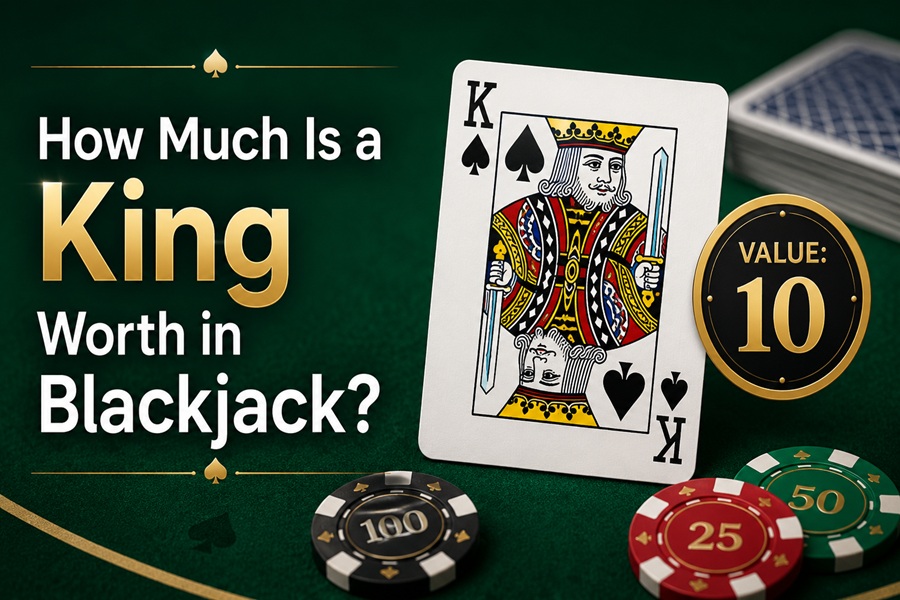

A King is worth 10 points in blackjack — always. The suit never matters. A King of Hearts, Spades, Diamonds, or Clubs is identical: 10 points. There is no situation in standard blackjack where a King counts as anything else.
That’s the short version. But the why behind it — and how the King fits into winning and losing hands — is where the real value is. Let’s break it down.
How much is a King worth in blackjack?
A King is worth exactly 10. It sits in the group of cards known as 10-value cards, alongside the Queen, the Jack, and the 10.
If you’re coming from poker, this trips people up. In poker, a King outranks a Queen, which outranks a Jack. In blackjack, that hierarchy vanishes at the point level. The King, Queen, Jack, and 10 are all worth the same 10 points. A King is not “better” than a Jack here.
This is one of the most-searched blackjack questions, and it usually comes from poker players expecting a ranking that simply doesn’t exist in this game.
What is every card worth in blackjack?
Blackjack uses a clean three-tier value system. Learn it once and every decision gets easier.
| Card | Value | Notes |
|---|---|---|
| 2 through 9 | Face value | Suit doesn’t matter |
| 10 | 10 | — |
| Jack | 10 | Face card |
| Queen | 10 | Face card |
| King | 10 | Face card |
| Ace | 1 or 11 | You choose whichever helps |
- Number cards (2–9): worth exactly what’s printed.
- 10-value cards (10, J, Q, K): all worth 10.
- Ace: the only flexible card — 1 or 11, whichever keeps you closest to 21.
To find your hand total, just add the cards. A King and a 7 is 17. A King and an Ace is 21 — a blackjack.
Why does the King’s value actually matter?
The King isn’t special on its own. What matters is that there are so many 10-value cards.
A standard 52-card deck holds 16 cards worth 10: four 10s, four Jacks, four Queens, and four Kings. That’s nearly one-third of the deck. This single fact drives almost everything in blackjack:
- Ten is the most common value you’ll draw. So you should generally assume the dealer’s face-down “hole” card is a 10.
- Hands jump in value fast. With so many 10s floating around, totals climb quickly — which is why the game moves at speed.
- It shapes basic strategy. Much of correct play assumes a strong chance of pulling a 10-value card next.
So when someone asks “how much is a King worth,” the deeper answer is: it’s worth 10, and there are 16 such cards, and that density is the engine of the entire game.
Is a King and an Ace a blackjack?
Yes — and this is the King’s best moment.
An Ace plus any 10-value card as your first two cards is a natural blackjack, totaling 21. So an Ace-King dealt off the top is a natural. At most tables it pays a 3:2 bonus, meaning a $10 bet returns $15 in winnings.
Two things to watch:
- A natural is only the first two cards. If you reach 21 with three or more cards, it’s still a win, but it usually pays even money (1:1), not the 3:2 bonus.
- Check the payout on the felt. Some tables pay only 6:5 on blackjack instead of 3:2. That quietly underpays your best hand and raises the house edge. Skip 6:5 tables when you can. Experienced players on forums like Reddit’s r/blackjack repeat this constantly — the 6:5 table is the single most common “beginner trap.”
What should you do when you have a King?
A King means you’re starting a hand with a strong 10. Here’s how that plays out:
- King + Ace → blackjack. Do nothing; collect.
- King + 10-value card → you have 20. Stand. This is a near-unbeatable total; don’t get greedy.
- King + low card → you have a hard total between 12 and 19. Play basic strategy based on the dealer’s up-card.
And here’s the mistake that costs players real money:
Never split a pair of Kings (or any 10-value pair). Two Kings give you 20 — one of the strongest hands in the game. Splitting turns one excellent hand into two mediocre ones starting at 10 each. Players do it for excitement. The math says stand.
Is a King strong when the dealer shows it?
When the dealer shows a King (or any 10-value card), the tables turn. That’s a strong dealer position.
Assume their hole card is likely a 10, giving them 20. And if they turn an Ace, they have blackjack and can’t be beaten. A dealer 10-up is one of the reasons you’ll be told to hit “stiff” hands (12–16) more aggressively against high dealer cards — standing and hoping the dealer busts is a losing bet when they’re sitting on a probable 20.
Does the King’s value change in blackjack variants?
The point value stays at 10 across nearly every version — classic, European, Atlantic City, Vegas Strip. But two variants are worth knowing:
- Spanish 21: All four 10-pip cards are removed from the deck, yet the Kings, Queens, and Jacks stay and still count as 10. Fewer 10-value cards changes the odds and the strategy, so Spanish 21 uses its own charts.
- Card counting systems: In the popular Hi-Lo count, every 10-value card — including Kings — counts as −1. When lots of Kings and other 10s have already left the shoe, the remaining deck favors the house, and skilled counters bet less. This is legal skill, though casinos dislike it.
A quick bit of history
Kings are among the oldest face cards. They trace back through early European decks — which arrived from the Middle East, with roots believed to reach China. In some older card games where the Ace is low, the King is the highest card. Blackjack flattens that ranking. Because the Ace works as both 1 and 11, and all face cards weigh the same, the King is forced to stand shoulder-to-shoulder with the Queen and the Jack at exactly 10.
Frequently asked questions
How much is a King worth in blackjack?
Exactly 10 points, regardless of suit. It never counts as anything else in standard blackjack.
Is a King worth more than a Queen or Jack?
No. All three face cards are worth 10. Poker rankings don’t apply in blackjack.
Is King-Ace a blackjack?
Yes, when they’re your first two cards. That’s a natural blackjack worth 21, usually paying 3:2.
Should I split two Kings?
No. Two Kings make 20. Stand. Splitting a 10-value pair is a classic costly mistake.
How many 10-value cards are in a deck?
Sixteen — four each of 10, Jack, Queen, and King. That’s why 10 is the most likely card value to appear.

