
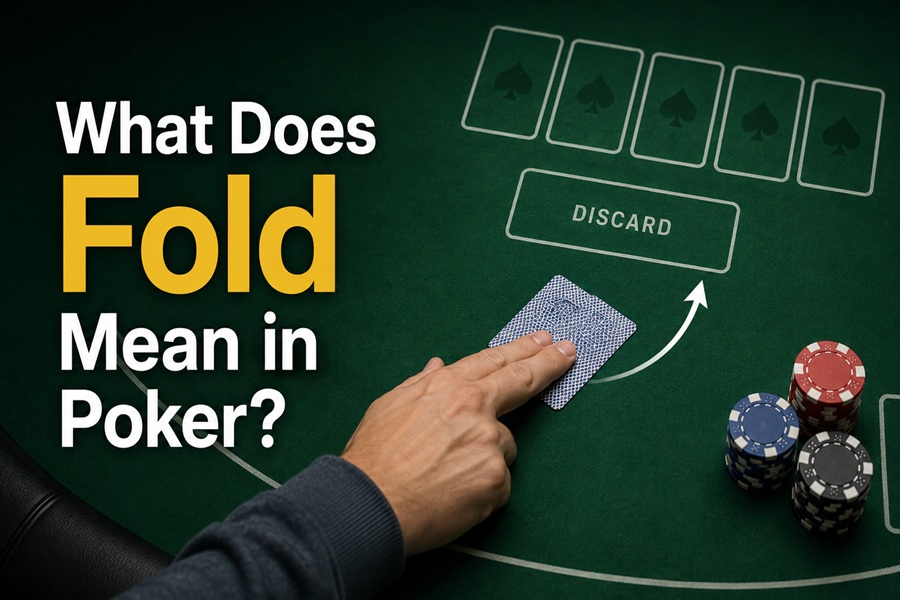

To fold in poker means to give up your cards and exit the current hand. You forfeit any chance at the pot and any chips you’ve already put in, but you avoid risking more. Folding is final — once your cards hit the muck or you say “fold,” you’re out. And here’s the surprise: folding is the single most common action good players take, often folding 70–80% of their starting hands.
Let’s unpack what it means, when to do it, and how to fold correctly.
What does fold mean in poker?
Folding means you surrender your hand and step out of the round. You lay down your two hole cards, and you’re done for that hand.
When you fold:
- You give up all claim to the pot. Even if your cards would have won by the river, you can’t win once you’ve folded.
- You stop putting chips in. You owe nothing more for that hand.
- Your decision is irreversible. Once the cards touch the muck or you verbally declare a fold, it’s binding.
Folding goes by a couple of other names at the table: “mucking” your hand or “laying it down.” They all mean the same thing.
How does fold fit with the other poker actions?
Fold is one of the basic moves available when the action reaches you. Depending on the situation, your options are:
| Action | What it means |
|---|---|
| Fold | Give up your hand and exit the round |
| Check | Pass the action without betting (only if no bet is live) |
| Call | Match the current bet to stay in |
| Bet | Put chips in when no one else has yet |
| Raise | Increase the current bet |
One key point: you can always fold when it’s your turn. The other options aren’t always available, but folding is. Generally, you fold when there’s a bet or raise in front of you and your hand isn’t strong enough to continue.
If everyone folds to a bet or raise, the player who made it wins the pot uncontested — no cards shown.
Why do winning players fold so much?
This is the mindset shift that separates beginners from pros. Folding isn’t quitting or weakness. It’s discipline.
In No-Limit Hold’em, players using solid starting-hand ranges fold roughly 70–80% of hands before the flop. That’s not being timid — it’s refusing to invest chips in weak spots.
Here’s the principle experienced players live by: a correct fold has an expected value of zero. You lose nothing more by folding a losing hand. Every chip you don’t lose in a bad spot is a chip you keep for a good one. Over thousands of hands, disciplined folding is one of the most profitable things you can do.
Winning threads on Reddit’s r/poker and coaching sites hammer the same lesson: most of poker is waiting, and folding well is how you wait.
When should you fold in poker?
Knowing what folding means is easy. Knowing when is the hard part. Here are the clearest spots to fold:
- You’re dealt a weak starting hand. Hands like 7-2 offsuit — the worst in Hold’em — should almost always go in the muck.
- You’re facing a bet and your hand can’t continue. If a raise is in front of you and you don’t have a hand worth calling, fold.
- You’re beaten and you know it. If the board and your opponent’s betting tell you you’re behind, don’t pay to find out. Lay it down.
- Your draw missed. Chasing a busted flush or straight into more bets bleeds chips.
- Position is against you. From early position, play a narrow range and fold marginal hands you might play later.
A few guiding rules from the pros:
Never get married to a hand. Even pocket Aces — the best starting hand — lose about 1 in 10 times against a random hand. When the board turns dangerous (say, three cards to a flush), be willing to fold even big hands.
The goal isn’t “can I win this hand?” It’s “does playing this hand help me win in the long run?“
How do you fold correctly? (Etiquette)
Folding the right way keeps the game fair and protects your own strategy. Follow these etiquette rules:
Do:
- Fold face down. Slide your cards toward the dealer without revealing them.
- Wait for your turn. Fold only when the action reaches you.
- Keep it smooth. A quiet, clean fold gives away nothing.
Don’t:
- Don’t fold out of turn. Acting early tells players still to act what you’re doing — that’s information you’re handing them for free, and it earns table disapproval.
- Don’t toss or “muck” cards carelessly. Flinging them can accidentally flip a card face-up and reveal your hand.
- Don’t show your fold while others are still in the hand. Exposing cards mid-hand gives live players extra information about what’s dead and what’s live.
| Situation | Face up or face down? |
|---|---|
| Others still have action | Face down, always |
| Your fold ends the hand (heads-up, opponent all-in, you’re done) | Face up is allowed, but hiding info is still wiser |
Once your cards touch the muck, they’re dead — even if you fold by mistake. So make sure before you let go.
Frequently asked questions
What does fold mean in poker? It means giving up your hand and leaving the current round. You forfeit the pot but risk no more chips.
Can you win after you fold? No. Once you fold, you have no claim to the pot, even if your cards would have won.
Is folding a lot a bad thing? No. Winning players fold most of their hands — often 70–80% pre-flop. It’s a core discipline, not a weakness.
Should you show your cards when you fold? Not while others are still in the hand. Fold face down to avoid giving away information. Showing is only acceptable when the hand is already over.
What’s the difference between fold and check? Checking keeps you in the hand without betting. Folding removes you from the hand entirely.