
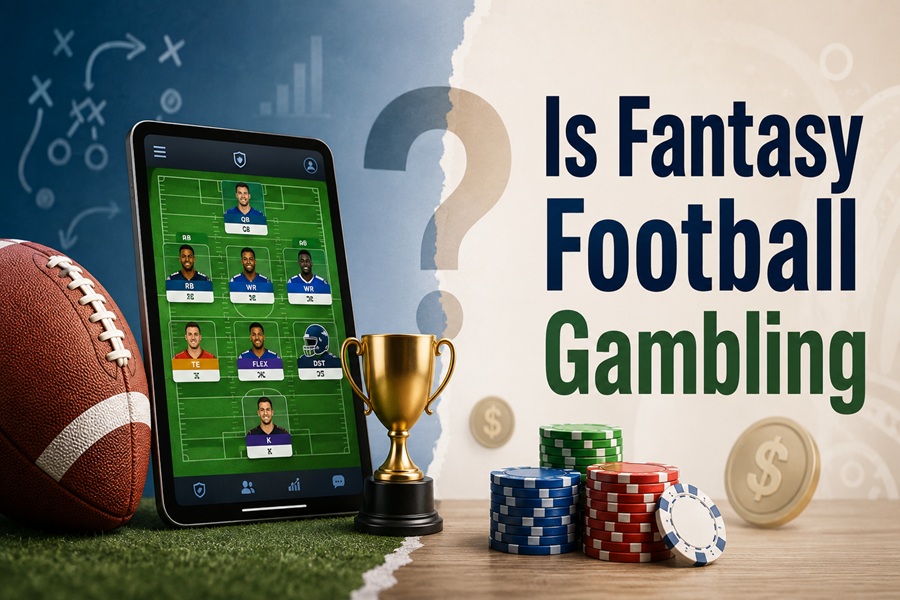

Fantasy football gambling sits in a gray zone. Under federal law, fantasy football is treated as a game of skill, not gambling, thanks to a carve-out written into the Unlawful Internet Gambling Enforcement Act. But it shares the core DNA of betting: you risk money to predict a sports outcome. So it is legally not gambling in most places, yet it can feel and function like gambling for the person playing it.
That gap between the legal label and the lived experience is where most of the confusion lives. Below is the full picture, from the skill-versus-chance debate to the brand-new prediction markets now reshaping the whole question.
Is fantasy football gambling?
To answer this, courts and lawmakers use a simple three-part test. Most U.S. states define gambling as an activity with all three of these elements:
- Consideration — you pay to play (an entry fee).
- Prize — you can win money or something of value.
- Chance — the outcome is decided mostly by luck.
Fantasy football clearly has the first two. The whole legal fight is over the third. Regulators concluded that fantasy football outcomes are driven predominantly by skill — research, roster construction, matchup analysis, injury tracking, and in-season management — rather than pure chance. Remove the “chance” leg, and it no longer meets the legal definition of gambling.
That said, chance never disappears. A star player can pull a hamstring in warmups. A blowout can bench your running back by halftime. A bad referee call can erase a touchdown. Over a single week, luck is loud. Over a full season, skill has more room to speak.
The honest version: Fantasy football is a skill game with a real chance component and real money on the line. The law calls it “not gambling.” Your bankroll may not notice the difference.
What is the legal difference between fantasy football and sports betting?
The cleanest way to see the difference is side by side. These four categories look similar from the outside but are treated very differently under the law.
| Activity | What you’re doing | Skill vs. chance | Legal status (federal view) |
|---|---|---|---|
| Season-long fantasy football | Draft and manage a roster over a full season | Highest skill weight | Game of skill; UIGEA carve-out |
| Daily fantasy sports (DFS) | Build lineups for a single slate of games | Skill-heavy, more variance | Game of skill in most states; restricted in a few |
| Pick’em / prop-style DFS | Pick players to go over/under a stat line | Blurs into betting | Banned or restricted in several states |
| Sports betting | Wager on a game or player outcome | Predominantly chance | Gambling; legal only where states allow |
The key phrase is “predominantly by skill.” Season-long leagues sit safely on the skill side. Traditional sports betting sits on the chance side. Daily fantasy lives in the middle, and the closer a DFS product looks to a straight over/under bet, the more regulators push back.
Is fantasy football legal in my state?
Federally, season-long and daily fantasy sports are generally legal. The friction is at the state level, and it comes in three flavors:
- Fully open states. Major operators like DraftKings, FanDuel, Underdog, and Sleeper run standard fantasy contests with no special restrictions.
- Regulated states. Some states require operators to hold a license and pay fees. That is why you sometimes see two big brands live in a state but smaller apps missing.
- Restricted or banned formats. A handful of states either restrict DFS entirely or have specifically outlawed pick’em-style contests that mimic prop betting. That is why a “pick more/fewer” product can vanish in one state while a draft-style contest stays live.
A few points worth knowing:
- Nevada treats DFS as gambling that requires a gaming license, so the national DFS apps generally do not offer standard contests there.
- Several states have banned or curbed pick’em products in recent years, pushing operators to redesign their games to stay compliant.
- “Not available in your state” on an app is often a company policy decision, not always a formal government ruling.
Bottom line: availability depends on your exact state and the specific contest format. Always check the app’s current state list before you deposit, because these rules move fast.
How are prediction markets changing the fantasy football gambling debate?
This is the newest and least-understood twist, and it barely appears in older “is fantasy football gambling” articles.
A wave of federally regulated prediction markets has entered the sports space. Instead of a sportsbook or a fantasy app, these are trading exchanges where you buy and sell “event contracts” on outcomes. They are overseen by the Commodity Futures Trading Commission (CFTC) — the same regulator that governs commodities futures — not by state gaming boards.
What is live now:
- Kalshi, Polymarket, and Robinhood began offering sports event contracts through this framework.
- FanDuel Predicts rolled out prediction markets in all 50 states, offering sports contracts in roughly 18 of them, including big non-betting states like California, Texas, and Florida.
- DraftKings Predictions launched across dozens of states, with sports contracts in a smaller subset.
- DFS-first brands like PrizePicks (via Kalshi) and Underdog now offer prediction-market selections too.
Why this matters for the fantasy football question:
- It routes around state gambling bans. Because these markets claim federal commodities regulation, they have gone live in states where sports betting is illegal.
- It blurs the skill line even further. A contract on “Player X to score a touchdown” looks a lot like a prop bet wearing a futures-market costume.
- It is legally contested. State regulators and tribes are challenging whether sports event contracts are really commodities or unlicensed gambling. Expect court fights.
For the everyday fan, the takeaway is simple: the wall between “fantasy” and “betting” is thinner than it has ever been, and prediction markets are the crowbar prying it open.
When does fantasy football gambling become a problem?
Ask around long enough on forums like Reddit’s r/problemgambling or recovery threads on Quora, and a pattern shows up again and again: people who said “it’s just fantasy, not real gambling” and used that label to justify escalating risk.
That framing is the danger. When something feels harmless, the guardrails come off.
Warning signs the community and clinicians consistently point to:
- You start placing side bets on the same games you’re watching for fantasy.
- You chase losses by upping entry fees or entering more daily contests.
- The result matters more than the game — you feel the dopamine swing of a win or loss.
- You hide how much you’re spending, or borrow to keep playing.
- Fantasy stops being fun and starts being a way to “get even.”
One point recovery communities stress: daily fantasy carries more risk than season-long play. The fast turnaround delivers quicker wins, losses, and dopamine hits, which is the same loop that drives slot machines and in-play betting.
If any of this feels familiar, the fix is not a better lineup. In the U.S., the 1-800-GAMBLER helpline offers free, confidential support 24/7.
Do you pay taxes on fantasy football winnings?
Yes. The IRS treats fantasy football winnings as taxable income, even the small consolation prizes and even if you never receive a tax form. Winnings of a certain size trigger reporting, and you are expected to report everything regardless.
If you win consistently, keep records. Winnings are taxable in full, and the rules for deducting related losses tightened recently, so casual “it all washes out” assumptions no longer hold.
Frequently asked questions
Is fantasy football illegal?
No. Season-long and daily fantasy sports are legal in most states under a federal game-of-skill carve-out. Some states restrict certain formats, and a few require licensing.
Is DFS the same as sports betting?
Legally, no. DFS is classified as a game of skill; sports betting is gambling. In practice, the two feel similar, and pick’em-style DFS sits closest to betting.
Are prediction markets legal for sports?
They operate under CFTC federal regulation and are live nationwide, but their legal status for sports is being challenged by states and tribes. It is unsettled.
Can you make money at fantasy football?
Skilled players can win over time, especially in season-long formats. But entry fees, rake, and variance mean most participants do not profit long term.
Why does fantasy football feel like gambling if it’s legal?
Because it has two of the three gambling ingredients — money in, prize out — and a real chance component. The law weighs skill heavily; your brain weighs the risk and reward.